
The only known archaeological deposit in Montana that is proximate to a proglacial lake, that is, Glacial Lake Great Falls (Fig. 10), is this site owned by Tag and Sandra Rittel of the Blacktail Ranch, Wolf Creek, Montana. The cave is located alongside the left bank of the South Fork of the Dearborn River (Fig. ).


Goshen Metzal

Figure 9. Reconstruction Of The Maximum Extent of Glaciers And Glacial Lakes In Montana During The Wisconsinan Stage Of The Pleistocene (after John Montagne 1972; Hill ).
Extinct mammals from Blacktail Cave include the giant short-faced bear (Arctodus simus), Arctic hare (Lepus arcticus), horse (Equus cf. conversidens) musk ox (Bootherium bombifrons), and Hibbard’s tundra vole (Microtus cf. paroperarius).
 Figure 10. Giant Short-Faced Bear With Cub After Dragging Carcass Of Bighorn Sheep Ram Into Blacktail Cave.
Evidence of such variation is apparent in the archaeological results forthcoming from By 9,500 B.P., or about 35 human generations into the past, Early Precontact hunter-gatherers had developed distinctive lifestyles that can be recognized and compared with others elsewhere.

Figure 11. Excavating Deep Paleontological Bone-Bearing Strata at Blacktail Cave (photo by Les Davis).
investigated sites. Figure 5 displays a key tangible form of technological variability upon which archaeologists rely to differentiate particular hunting adaptations. Projectile points are missiles propelled by the use of lances and/or dart throwers. Radiocarbon dates establish the age Before Present (B.P.) for each point form. Upon those two bases and others, when available, culture complexes are identified and differentiated. Those distinctions enable characterization of lifeways regarded herein as culture complexes.
 Figure 12. Excavating Inside Blacktail Cave Using Fluorescent Lights To Enhance Visibility (photo by Les Davis).
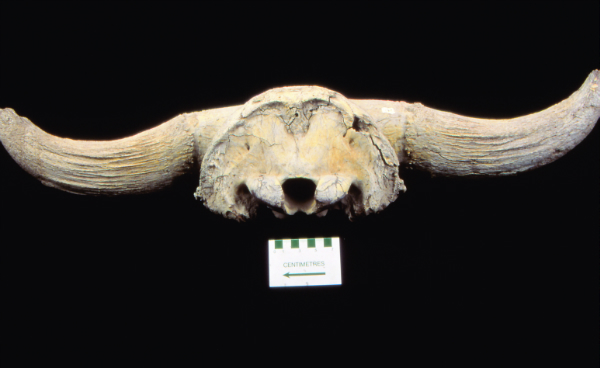 Figure 13 . The Skull Of An Extinct Form Of Bison Retrieved From Blacktail Cave.
 Figure 14. Graphic Display of Projectile Points Relative to Radiocarbon-Dated Time Span For Each Early Precontact Culture Complex.