
Lewis & Clark
by Ken Sinay
Considering the members of the Lewis and Clark expedition covered more miles in what is now Montana than in any other state, had some of their most dramatic experiences and life-threatening adventures here, and that members of the expedition passed through the Gallatin Valley twice in two years and, in fact, right through where downtown Bozeman is today, I think we can understand why some interest might exist in the Bozeman area on this subject.
The release of the Ken Burns video Lewis & Clark: The Journey of the Corps of Discovery and the publication of Undaunted Courage by Stephen Ambrose certainly generated interest in the expedition of Lewis and Clark on both a national and local level. But these resources, while popular and easy to experience, are just the tip of the iceberg when it comes to productions relating to this historic journey.
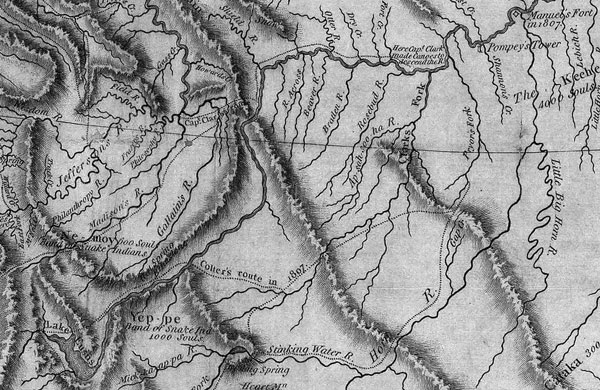 Lewis & Clark’s map published in 1814.Everyone’s heard of the journals of Lewis and Clark, but it’s not quite that simple. Six members of the Corp of Discovery, including Lewis and Clark, journalized. Their journal entries are often so detailed that we can vicariously join them on their expedition almost 200 years ago. In a similar way, the observations they present are our best evidence of what the Great Plains and Rocky Mountains were like prior to the invasion of white settlers. Stephen Ambrose primarily used the journals to create his best-selling book.
You and I can experience the documented adventures of Lewis and Clark firsthand. How do we do this? By reading the journals. One of the great aspects of the Lewis and Clark expedition is that this is not a realm exclusive to professional academics, scientists, or historians. You and I have access to the same information they do. The only complication is that all published versions of the journals are edited from the originals. The originals are voluminous, unbound, and contain tremendous amounts of detailed notes relating to mapping and climate. Poor spelling, imprecise grammar, and an abundance of colloquial terms can also make them difficult to read.
The most popular version of the journals is The Journals of Lewis and Clark as edited by Bernard DeVoto. DeVoto streamlined the journals, eliminating notes the casual reader would probably not be interested in, but retaining information about wildlife, Indians, and exciting experiences. His version reads smoothly and as a continuous narrative.
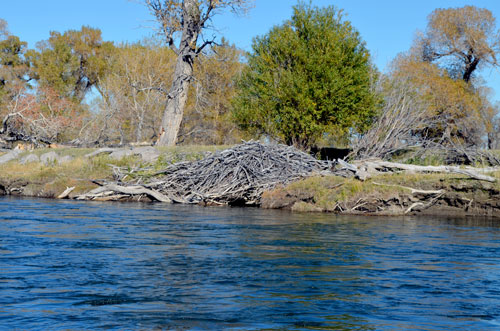 Beaver dam along the Yellowstone River east of Livingston, MT. Daniel J. Smith photo.There are other editions of the journals, and each is historically significant. There are also numerous books relating to specific aspects of the journey such as natural history and Native Americans. In September of 1999, The Journals of the Lewis and Clark Expedition (12 volumes), edited by Gary Moulton, was completed and released. This monumental project will likely remain the authoritative edited version of the journals for as long as the sun shines on the land as we know it. Moulton tried to directly transform all the recorded information into an indexed and functional form suitable for everyone. For example, volume one is nothing but maps. Each map shows intimate features of the landscape. Included are the junctions of the Gallatin, Madison, and Jefferson Rivers to form the Missouri. Landscape and wildlife information is often included on these maps. Volume 12 contains all the plant-related information of the expedition. In between is the text of the journals as spelled out by the original authors.
Considering that the Moulton Edition of the journals costs close to $1,000, you may not wish to run out and pick up a copy. But there is an excellent alternative. Lewis and Clark in the Three Rivers Valleys, edited by Don Nell and Jack Taylor, is the compiled journals of all the members of the expedition who journalized for our regional area. I think of Don and Jack as “just the facts ma’am” kind of guys. They, like Moulton, have tried to accurately reproduce the journal texts and make them available to the public — but their version comes at an affordable price. In their case, they also include maps that trace the course of the expedition on the contemporary landscape. This makes it easy to follow the “trail” today.
In the Gallatin Valley, and across Montana, much of the landscape and diversity of wildlife experienced by the members of the Corp of Discovery still remains. We have the opportunity and privilege of being able to directly follow the path of Lewis and Clark across this wonderful state to see much of what they saw, and feel much of what they felt. Their notes and observations on wildlife and Native Americans are invaluable to those who attempt to understand our relationship to the land today.
When we study and investigate history, we are always interpreting the past. Often we rely on authors, historians, or filmmakers to interpret for us. In the case of Lewis and Clark and the Corps of Discovery, we have the opportunity to interpret for ourselves.
Editor’s Note: Ken Sinay created Northern Rockies Natural History in 1991 to share his love of our wildland heritage with others. He changed the company name to Yellowstone Safari Company (YSC) in 2001. Ken’s Bachelor of Science and graduate studies focused on Wildlife Biology and Natural Resource Management. His professional and technical environmental career includes: Montana Dept. of Fish, Wildlife & Parks, US National Forest Service, Montana Nature Conservancy, Museum of the Rockies (Montana State University), AMAX Coal Co., US Fish & Wildlife Service, and private wilderness outfitters. Ken’s knowledge, enthusiasm and experience are evident in the quality of his tours and presentations. A devoted conservationist, his personal goal is to provide guests with the most rewarding experience possible, resulting in lifetime memories of the wildlife diversity and rich history of the Greater Yellowstone ecosystem.
For a complete bibliography of Lewis and Clark publications, contact the Lewis and Clark Trail Heritage Foundation at 888-701-3434, or look them up on the Web at www.lewisandclark.org. Or e-mail Ken Sinay at ken@YellowstoneSafari.com.
This article first appeared in Outside Bozeman Magazine